
Do Online Quran Classes Really Work?

This question deserves a direct, evidence-based answer rather than a marketing pitch, so this article looks at it the way a genuinely skeptical parent or adult learner would want it examined. What does working actually mean, what does the real experience of thousands of students over the past several years actually show, and where are the legitimate limitations worth knowing about before you commit. Let us go through it piece by piece.
Defining What Working Actually Means
Before answering whether online classes work, it helps to define the standard being used. If working means producing students who can read the Quran accurately, apply Tajweed correctly, and in many cases go on to memorize significant portions or complete an Ijazah, then the honest answer, backed by the outcomes of countless students over recent years, is yes, consistently and reliably, provided the program and teacher are genuinely qualified.
The Skeptical Starting Point Is Reasonable
Skepticism about a screen replacing traditional in-person religious instruction is entirely reasonable given how central physical presence has always been to how Islamic knowledge is traditionally transmitted. This article does not dismiss that skepticism. It simply lays out what the actual evidence and experience show once the format has been tried in earnest rather than judged from the outside.
Evidence Point One: Reading Fluency Outcomes
Students starting as complete beginners with no letter recognition consistently reach genuine reading fluency within roughly twelve to eighteen months of consistent online Quran classes, a timeline comparable to what would be expected from consistent in-person instruction. This outcome has repeated itself across a wide range of ages and backgrounds, suggesting the format itself is not the limiting factor.
Evidence Point Two: Tajweed Correction Actually Happens in Real Time
A common worry is that a teacher cannot properly hear or correct pronunciation through a screen. In practice, modern audio quality is more than sufficient for a trained ear to catch subtle pronunciation errors, and teachers report correcting students in real time just as they would in person, simply through a different medium of transmission.
Evidence Point Three: Memorization Programs Produce Real Results
Students pursuing online Quran memorization programs regularly complete meaningful portions of memorization, sometimes progressing through multiple Juz over a year or two of consistent study, following the same structured review and repetition methods used in traditional memorization programs, simply delivered through live video sessions instead of an in-person classroom.
Where Online Classes Genuinely Struggle
It would be dishonest to claim there are no limitations at all. Students with very poor internet connectivity, families without a quiet space free of interruptions, or students working with an unqualified or poorly matched teacher can and do struggle, exactly as they would with a poorly run in-person program. These limitations are about specific circumstances and program quality, not an inherent flaw in the online format itself.
What Separates Programs That Work From Those That Do Not
The programs and teachers that produce strong, verifiable outcomes share a few common traits: qualified teachers with real Tajweed and Quran credentials, small class sizes or true one-on-one instruction, consistent weekly scheduling, and a structured curriculum that builds progressively rather than jumping around without clear direction.
Addressing the Comparison to Passive Online Courses
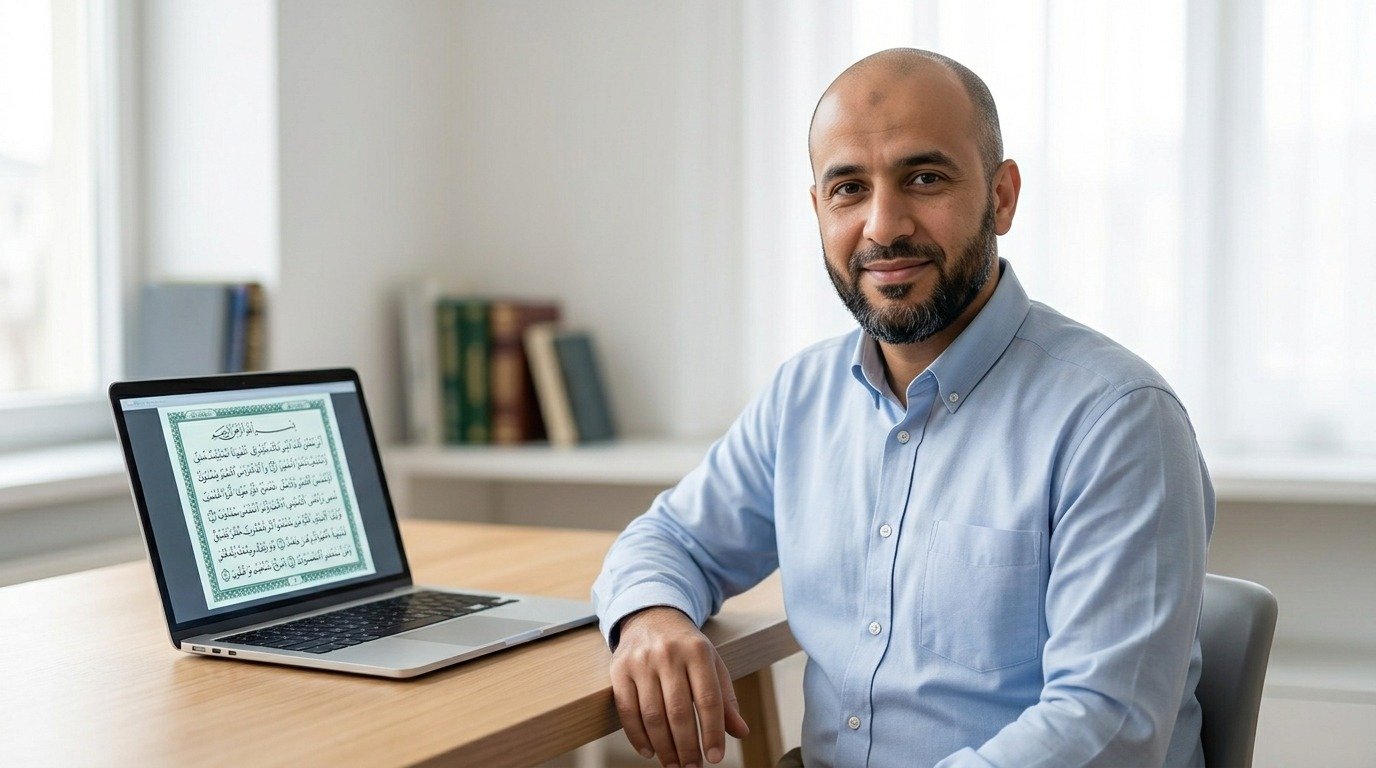
Part of the skepticism around online Quran classes comes from confusing them with passive, pre-recorded online courses common in other subjects, where a student watches a video and has no real interaction with an instructor. This is not how legitimate online Quran instruction works. Sessions are live, interactive, and typically one-on-one or in very small groups, with constant back and forth between teacher and student throughout the entire lesson. This distinction matters enormously, since the effectiveness concerns that legitimately apply to passive video courses simply do not apply to live, interactive instruction.
What Long-Term Students Report About Their Own Experience
Students who have been learning online for a year or more consistently describe the experience as feeling remarkably similar to in-person instruction once the initial adjustment period passes. Most say the format itself faded into the background within the first month, leaving simply the relationship with their teacher and the actual content of the lessons as what mattered from that point forward. This pattern holds across a wide range of ages, from young children to older adults.
How Teachers Themselves Describe the Shift to Online Instruction
Experienced Quran and Tajweed teachers who have taught both in-person and online for extended periods often describe an adjustment period on their own end as well, learning to rely more heavily on close visual attention to a student's mouth and careful listening rather than any physical proximity. Many report that after this adjustment, they can correct students just as effectively online, and some even note that the camera's close-up view of a student's mouth can actually make certain corrections easier to spot than they would be from across a room in a traditional classroom.
Specific Data Points Worth Knowing
While every program and student differs, certain patterns show up reliably across large numbers of online Quran students. The vast majority of students who complete a full foundational reading program, such as the Noorani Qaida, go on to develop genuine reading fluency within the expected timeframe. Retention rates for students who maintain consistent weekly attendance for at least six months are notably higher than for those who attend sporadically, reinforcing that consistency, not the format itself, is the primary driver of success or failure.
Common Objections and How They Hold Up Under Scrutiny
Objection: a screen cannot replace the spiritual atmosphere of learning in person. This is a legitimate point about atmosphere and community, but it is a separate question from whether the actual instructional content, reading accuracy and Tajweed correction, transfers effectively online. On that specific, measurable question, the evidence is clear that it does.
Objection: children cannot focus long enough through a screen for real learning to happen. In practice, well-structured online sessions for children are typically shorter and more focused than a comparable in-person group class segment, and the one-on-one attention often keeps a child's focus more consistently engaged than sitting in a group waiting for a turn would.
Objection: online teachers cannot verify a student is actually reading correctly rather than reciting from memory while looking away from the text. This is a fair technical concern, and experienced teachers address it directly by regularly testing students on unfamiliar passages rather than only reviewing familiar material, exactly as a careful in-person teacher would do as well.
How to Verify a Specific Program's Track Record Before Committing
Rather than relying on general claims about whether online Quran classes work, it is entirely reasonable to ask a specific program directly about their students' typical progress timelines, teacher qualifications, and whether they offer a trial lesson before requiring a longer commitment. A program confident in its own effectiveness should have no hesitation providing this information directly and transparently.
The Role of Parental Involvement in Measuring Real Effectiveness
For children specifically, effectiveness is easiest to verify when a parent stays reasonably engaged with the process, occasionally sitting in on part of a session, reviewing what the teacher notes as progress each week, and periodically checking whether a child can read an unfamiliar short passage independently. This kind of light but consistent oversight gives a parent direct, firsthand confirmation of whether the format is genuinely producing results for their specific child, rather than relying purely on general claims from any article, including this one.
What Happens When Online Classes Do Not Work
It is worth examining honestly the cases where online Quran classes genuinely fail to produce good results, since understanding these failure cases actually strengthens confidence in the format overall by clarifying what specifically needs to be in place. In nearly every documented case of a family feeling disappointed with online learning, the root cause traces back to one of a small handful of specific issues: an unqualified or poorly matched teacher, highly inconsistent attendance, a chronically unstable internet connection, or unrealistic expectations about how quickly progress should happen.
None of these causes are unique to the online format. Every one of them would produce similarly disappointing results in a traditional in-person program as well. This is an important distinction, because it means the format itself is rarely the actual source of failure, even in the cases where families feel the approach did not work for them.
How Online Ijazah Programs Demonstrate the Format's Rigor
Perhaps the strongest evidence that online Quran instruction genuinely works comes from the existence and success of online Ijazah programs, which require a very high standard of verified accuracy and mastery before a certification is granted. These programs would not exist, or would quickly lose credibility, if the online format could not reliably produce the precise level of Tajweed accuracy and recitation skill an Ijazah demands. Their continued operation and the students who successfully complete them stand as concrete proof that the format supports even the most rigorous levels of Quranic instruction, not just basic introductory reading.
Comparing Long-Term Retention Between Formats
A reasonable question beyond initial learning is whether skills learned online stick over the long term as well as skills learned in person. Available evidence suggests retention depends far more on ongoing practice and periodic review after initial learning than on which format was originally used to acquire the skill. A student who stops practicing after reaching fluency will see some decline in sharpness regardless of whether they originally learned online or in person, while a student who continues regular practice retains their skill well under either format.
A Direct Comparison of Typical Outcomes After One Year

Consider a realistic comparison after one full year of consistent instruction. A complete beginner attending consistent weekly online sessions with regular home practice typically reaches solid reading fluency and beginning Tajweed competence within that year. A similarly consistent student in a traditional in-person weekly program typically reaches a broadly comparable point. The outcomes converge much more than the ongoing skepticism about online learning might suggest, precisely because the actual mechanism of learning, live correction and repeated practice, is preserved across both formats.
Why This Question Keeps Coming Up Despite the Evidence
Given how consistently the evidence supports online Quran instruction working effectively, it is worth briefly addressing why the skepticism persists so strongly in some circles. Part of it is simply generational, since older generations associate religious education inherently with physical mosque attendance and in-person scholarly transmission. Part of it is a reasonable caution about a relatively newer format compared to centuries of established in-person tradition. And part of it is that people naturally remember the occasional disappointing online experience more vividly than the many successful ones that simply worked quietly and as expected.
How to Move Past Skepticism Productively
Rather than resolving the skepticism through argument alone, the most productive path is usually a direct trial. A single trial lesson reveals far more about whether the format will work for a specific student than any amount of reading or discussion can. Most reputable programs offer this specifically because they know firsthand experience tends to be far more convincing than any written explanation, this article included.
What Parents Specifically Should Watch for as Evidence of Progress
For parents wanting concrete, observable evidence that online classes are actually working for their child, a few signs are worth tracking directly rather than taking a teacher's word alone. A child should gradually need fewer reminders for previously covered material, should show increasing comfort reading unfamiliar short passages rather than only familiar ones, and should be able to explain, in simple terms, why a specific Tajweed rule applies where it does rather than just applying it by rote without understanding.
These observable markers give a parent direct confidence that real learning is happening, separate from simply trusting general claims about the format's effectiveness.
The Financial Angle: Does Working Also Mean Good Value
Effectiveness and value are related but distinct questions. Even a program that produces strong learning outcomes should also represent reasonable value for the cost involved, especially compared to the total cost, including time and travel, of an equivalent in-person alternative. Most families find that once the reduced overhead of not needing to drive anywhere is factored in, online instruction offers a genuinely favorable balance of cost and outcome, though pricing structures vary meaningfully between different programs and are worth comparing directly.
A Broader Look at Why the Underlying Method Has Always Mattered More Than the Medium
Quran instruction, at its core, has always relied on a knowledgeable teacher listening closely and correcting a student's recitation through repeated practice. That fundamental method predates video calls by many centuries and does not actually depend on physical proximity in the way people sometimes assume. What has changed is simply the medium carrying that same interaction across distance, and the underlying method, close listening and immediate correction, remains just as intact online as it ever was in person.
Setting Realistic Expectations Rather Than Chasing Perfection
Part of genuinely answering whether online classes work involves being honest about what realistic success looks like versus an unrealistic standard of instant or effortless mastery. No format, online or in-person, produces fluent Quran reading within a few weeks or without consistent effort sustained over months. Judging online classes against a realistic standard, comparable steady progress over a comparable timeframe to traditional instruction, is the fair test, and it is the test the format consistently passes.
Final Thoughts From Both Sides of the Camera
Ask a teacher who has spent years working with online students, and ask a parent whose child has been learning online for a year or more, and both tend to arrive at a similar, grounded conclusion. The format is not magic, and it does not eliminate the need for real effort, consistency, and a genuinely qualified teacher. But within those same requirements that any effective learning arrangement needs, online Quran classes do work, reliably and repeatedly, for students willing to show up and put in the practice.
What This Means for Someone Still Deciding
If you are reading this article specifically because you are trying to decide whether to commit to an online program for yourself or your child, the honest, evidence-supported answer is that the format itself should not be the source of your hesitation. The far more important questions to focus your decision on are whether a specific program has genuinely qualified teachers, whether the schedule and structure fit your family's actual life, and whether you are prepared to maintain the consistency that any effective learning process, in any format, ultimately requires.
Answer those three questions well, choose carefully, and the evidence strongly suggests the results will follow, regardless of whether the lessons happen in a room down the street or through a screen from your own living room.
The evidence gathered across thousands of students, teachers, and years of real-world experience points clearly in one direction. Online Quran classes do work, not as a lesser substitute for something better, but as a genuinely effective format in its own right when the fundamentals of good teaching and consistent practice are in place.
Skepticism is a healthy starting point for any decision this important, but it should be resolved through direct experience and honest evaluation of a specific program, not dismissed outright or accepted blindly based on marketing claims from either side of the debate.
Try a real lesson, watch what actually happens over the following weeks, and let that direct evidence, rather than any general debate about the format, guide your final decision.
Thousands of students before you have already answered this question through their own real progress, and there is no reason your own experience would look meaningfully different, provided the same fundamentals of good teaching and consistent effort are genuinely in place from the start.
The question was never really whether a screen can teach the Quran. It was always whether a qualified teacher and a committed student can produce real learning together, and a screen has never actually stood in the way of that happening.
Whatever hesitation remains after reading all of this is worth resolving through direct experience rather than further debate, since that experience, more than any article, will give you the clearest and most personally relevant answer of all.
So yes, online Quran classes really do work, and the many students already reading fluently, applying correct Tajweed, and progressing steadily through memorization are the clearest proof of that available today.
Let their results stand as your answer, and let your own trial lesson confirm it for yourself.
There is no remaining reasonable doubt left to address here beyond what a single real class, taken with an open mind, can settle for you far more convincingly than any further reading ever could.
The proof, in the end, is always in the practice, and that practice has already been carried out successfully by more students than any single article could ever fully describe.
Take that first step, and let your own results become the final answer to a question this article has already answered as clearly and honestly as the available evidence allows.
Bringing It Together
Yes, online Quran classes really do work, supported by consistent outcomes across reading fluency, Tajweed accuracy, and memorization achievement among students who commit to the process with a genuinely qualified teacher. The skepticism many people bring to this question is reasonable, but it does not hold up against the actual track record once examined closely. For families anywhere, including those exploring online Quran classes in Los Angeles, the real determining factor is not the format itself but the quality of the specific program chosen.
If you still have doubts, the most direct way to test this for yourself is a trial lesson, which you can request through the contact page before committing to anything further.
Add New Comment