

Why Consistency Is More Important Than Long Lessons
Two families, same total weekly time investment, wildly different results, and the difference has nothing to do with talent, motivation, or how much either family cares about the outcome. One practices Quran for ten minutes every single day. The other saves it all up for one seventy minute session on Sunday. On paper, they've committed the same amount of time. In practice, the daily family almost always ends up further ahead, with stronger retention and steadier progress. This article walks through why that happens and makes the case, directly, for why a short consistent routine beats an occasional long one, even when the total hours look identical.
The Case for Long, Infrequent Sessions
It's worth being fair to the long-session approach before dismantling it, since it does have some genuine appeal. A single longer session is easier to schedule around a busy week, since it only requires finding one open block rather than protecting a slot every single day. It can also feel more substantial in the moment, a full hour of focused work feels like "real progress" in a way that ten scattered minutes sometimes doesn't. For families with genuinely unpredictable weekday schedules, a single weekend session can feel like the only realistic option available.
There's also an argument that longer sessions allow for deeper, more sustained work on a single passage without the interruption of starting and stopping every day. For older students with strong attention spans, an extended session can accommodate more complex material in one sitting than a short daily session ever could.
The Case for Short, Consistent Sessions
Now the other side, and this is where the evidence and experience both point strongly in one direction. Short daily sessions take advantage of spaced repetition, a well established principle in how memory works, where information reviewed in small doses across multiple days sticks far better than the same amount of exposure crammed into a single sitting. A child practicing ten minutes daily gets seven separate opportunities each week for the brain to encode and strengthen new material, compared to just one opportunity in a single weekly session, even though the total time invested is the same.
Short sessions also protect focus quality. Attention, especially for children, isn't a resource that stays constant across an hour. It peaks early and fades, meaning the back half of a long session often produces far less real learning per minute than the front half. A ten minute session, by contrast, can stay almost entirely within a child's genuine focus window, meaning nearly all of that time produces real, usable learning rather than diminishing returns.
Consistency also builds habit strength in a way occasional sessions never can. A daily ten minute commitment becomes automatic, something the brain and body expect and settle into without much resistance, the same way brushing teeth becomes automatic through daily repetition. A weekly hour-long session never gets the chance to become automatic in the same way, since there's too much time between occurrences for the routine to solidify into habit.
A Note on Parental Effort, Not Just Child Effort
It's worth acknowledging that short daily sessions ask something different of parents too, not necessarily more effort overall, but a different kind of effort spread differently across the week. A single long weekly session concentrates parental involvement into one demanding block, while daily short sessions ask for smaller, more frequent check-ins. Some parents find the daily rhythm easier to sustain precisely because each individual session asks so little, while others initially find the idea of a daily commitment more daunting than a single weekly block, even though the total time is the same or less. Recognizing your own honest reaction to each format, rather than assuming one is automatically easier, is worth factoring into which approach your family ultimately settles on.
Comparing the Two Directly: What a Typical Week Looks Like
Picture the daily family: ten minutes each morning, five or six days a week, roughly sixty minutes total. Each session starts with a brief warm-up on familiar material, moves into a small amount of new content or focused review, and ends before attention has a chance to fully fade. By the end of the week, that family has had six separate opportunities to encode, review, and reinforce material, spaced out in a way that maximizes retention.
Now picture the weekend family: one seventy minute session on Sunday. The first fifteen or twenty minutes are genuinely productive, sharp focus, good progress. But somewhere past the halfway mark, attention starts to fray, review starts to feel repetitive, and the back third of the session often produces frustration more than learning. By the following Sunday, six full days have passed since the last exposure to the material, plenty of time for meaningful fading to occur, meaning a chunk of that next session gets spent simply re-establishing what was already covered the week before, rather than making genuinely new progress.
The Compounding Gap Over a School Year
This difference doesn't stay small. It compounds. Over a school year, the daily family has had roughly two hundred separate practice sessions, two hundred distinct opportunities for spaced reinforcement. The weekend family has had around forty, with a large fraction of each session spent re-covering ground lost to a full week of fading in between. By the end of the year, even though both families invested roughly the same total hours, the daily family typically shows meaningfully more retained memorization and stronger reading fluency, simply because of how those hours were distributed across time.
Why This Matters More for Younger Children
The gap between these two approaches widens further with younger children, whose attention spans and working memory capacity are naturally more limited. A five or six year old genuinely cannot sustain seventy minutes of focused Quran work, no matter how the session is structured, which means a long weekly session for a young child isn't really seventy minutes of learning, it's fifteen or twenty minutes of real engagement surrounded by fifty minutes of diminishing returns and mounting frustration. A short daily session, by contrast, stays entirely within a young child's realistic attention window, meaning essentially all of the time invested produces genuine learning.
What This Looks Like for Reading Fluency, Not Just Memorization
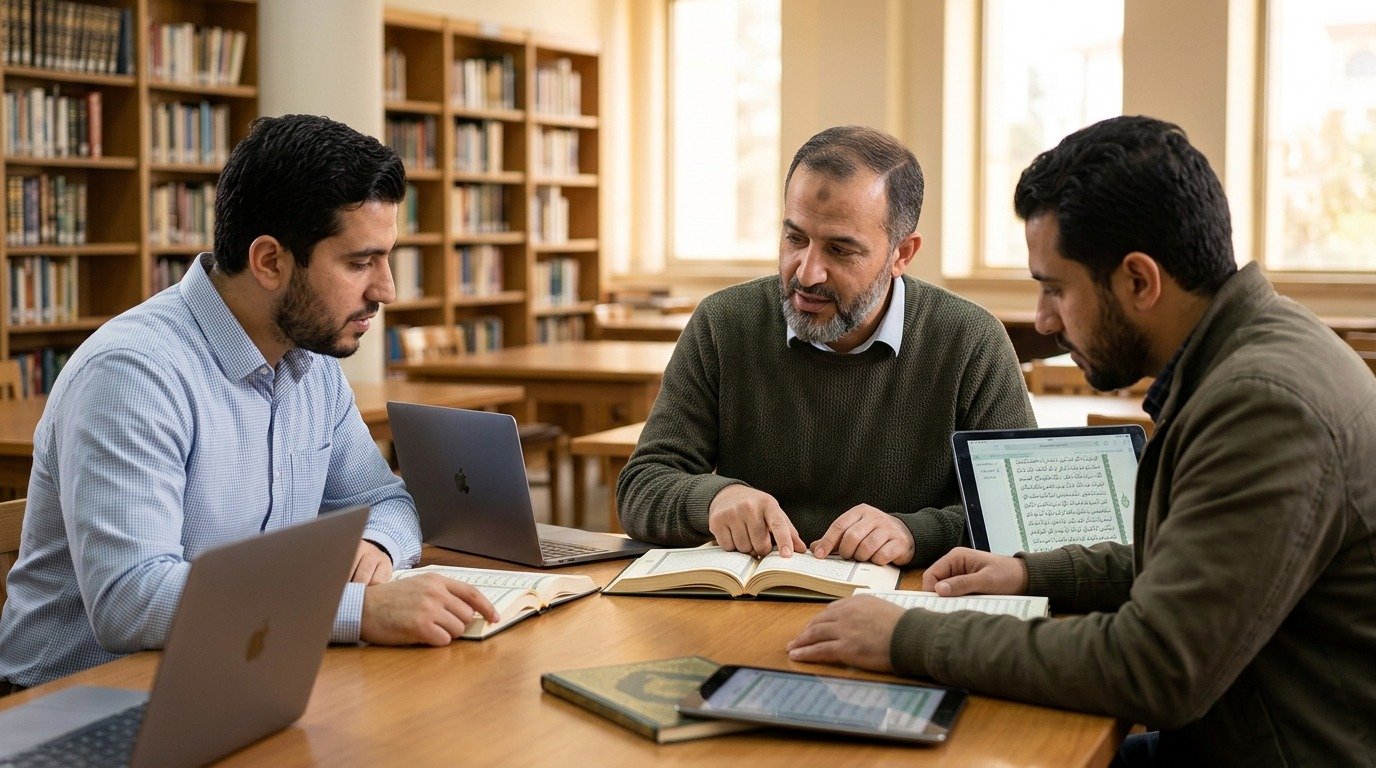
The consistency advantage isn't limited to memorization. Reading fluency, the ability to decode Arabic script smoothly and apply tajweed rules automatically, also builds far more efficiently through short, frequent exposure than through occasional long sessions. A child reading a small amount of new text daily, with immediate correction of mistakes, develops smoother, more automatic reading skills than a child attempting the same total reading volume in one long weekly sitting, where fatigue sets in well before the session ends and later mistakes go uncorrected simply because attention has already faded.
This matters because families sometimes assume the consistency principle applies only to memorization and treat reading practice differently, saving it for a longer weekend session. The underlying cognitive mechanisms are similar enough that the same daily, spaced approach tends to produce stronger reading fluency gains as well.
Where Long Sessions Still Have a Place
None of this means longer sessions are always wrong. Older students and adults with more developed attention spans can genuinely benefit from occasional longer, deeper sessions, particularly for consolidation work like reciting a full juz start to finish, which requires sustained focus that a short daily session can't accommodate. The healthiest approach for many families isn't choosing exclusively between short daily sessions and long occasional ones, but combining them: short daily sessions as the backbone of the routine, supplemented occasionally by a longer session for specific consolidation work that genuinely benefits from extended, uninterrupted time.
What Happens When Families Switch From Long to Short Sessions
Families who've tried both approaches and switched from infrequent long sessions to short daily ones often describe a similar arc. The first week or two feels strange, ten minutes seems too short to accomplish anything meaningful, and there's a temptation to skip a day here and there since the individual sessions feel low-stakes. By the third or fourth week, though, most families notice the routine has become genuinely automatic, and more importantly, they notice their child retaining material between sessions far better than before, since there's no longer a full week for fading to set in between exposures.
This transition tends to go more smoothly with support from a structured program rather than trying to redesign the routine entirely alone. Teachers working through online Quran classes often guide families through exactly this shift, helping set realistic daily session lengths and providing the external accountability of a scheduled lesson that makes the daily habit easier to protect consistently.
What a Teacher Notices About the Two Approaches
Teachers who have worked with many students over the years tend to develop a fairly reliable sense of which pattern a given family is following, often within the first few weeks of lessons. Students on a short, consistent daily rhythm tend to arrive at each lesson with material genuinely fresh and mostly intact, allowing the lesson time to focus on new progress rather than repair. Students relying on occasional long sessions often arrive at lessons having lost noticeable ground since the previous one, meaning a chunk of each lesson gets spent simply reestablishing what should already be solid, leaving less time for genuine forward progress within the lesson itself.
This pattern is often visible enough that an experienced teacher can gently flag it to parents well before the underlying issue becomes a bigger problem, offering a useful outside check that's harder to get from self-assessment alone, since it's easy for a busy family to underestimate how much a single weekly session is actually costing them in lost ground between sessions.
The Same Principle Applies to Tajweed
This isn't unique to memorization. Correct pronunciation habits, the foundation of good tajweed, also benefit far more from short, frequent, corrected practice than from occasional long sessions. A student working through online Tajweed classes who practices pronunciation daily in small doses, with regular correction, tends to internalize correct habits far more reliably than a student attempting to absorb the same total correction time in one long weekly session, where early corrections are often forgotten by the time later material is reached.
Applying This to Hifz Specifically

For students working specifically toward significant memorization goals through online Quran memorization classes, this principle becomes even more pronounced, since hifz depends so heavily on the kind of spaced repetition that daily practice naturally provides. A student attempting to build serious memorization volume through infrequent long sessions alone will almost always progress more slowly, and retain less, than a student following a short daily rhythm, even if the weekly hours invested are identical on paper.
Beyond Quran: Why This Principle Shows Up Everywhere
It's worth noting that this isn't a phenomenon unique to religious education. The same pattern shows up in language learning, musical instrument practice, and academic skill building generally: short, frequent, spaced practice consistently outperforms long, infrequent cramming across nearly every domain that's been studied. Recognizing that Quran memorization follows the same underlying principle as these other well documented learning contexts can help families trust the approach even when a single ten minute session feels almost too modest to matter in the moment.
Making the Switch in Your Own Family
If your family currently relies on a single long session, whether out of scheduling necessity or simple habit, consider experimenting with breaking it into shorter daily pieces instead, even if the total weekly time stays roughly the same. Start with something modest, ten minutes most days, and give it three or four weeks before judging the results. Most families who make this switch are genuinely surprised at how much more their child retains, and how much less resistance there is to a short daily commitment compared to one large weekly obligation that always seems to loom over the whole week.
Bringing Consistency Into the Rest of Islamic Learning Too
This same principle extends naturally beyond Quran practice specifically. Families who weave in short, regular touches of broader Islamic studies throughout the week, rather than saving all religious education for one concentrated weekend block, tend to see similar benefits: steadier engagement, better retention of concepts and stories, and a sense that Islamic learning is a natural daily thread through family life rather than a separate, occasional obligation.
What the Research on Memory Actually Says
The advantage of spaced practice over massed practice, the technical terms researchers use for what we're calling short-consistent versus long-infrequent here, has been documented across more than a century of memory research, going back to some of the earliest formal studies of learning and retention. The core finding holds up remarkably consistently across different types of material, languages, motor skills, factual knowledge, and yes, memorized religious text: information reviewed in spaced intervals is retained significantly better over the long term than the same amount of exposure delivered in one concentrated block.
The reason has to do with how memory consolidation works at a biological level. Each time information is recalled after a period of time has passed, rather than while it's still fresh in short-term memory, the brain strengthens that memory trace more robustly than it would from simply repeating the information immediately. A single long session mostly draws on short-term memory and immediate repetition, which feels productive in the moment but doesn't build the same durable long-term retention that spaced recall produces.
A Common Objection: "We Don't Have Time Every Day"
This is the most frequent pushback families raise, and it deserves a direct, honest response. Genuinely committing ten minutes daily is, for the overwhelming majority of families, more realistic than it initially feels, precisely because ten minutes is small enough to fit into existing daily routines rather than requiring a newly carved out block. The families who say they don't have time daily are often unconsciously comparing a daily commitment to their current single weekly session, when the more honest comparison is ten minutes spread across a day that already contains meals, school pickup, and dozens of other small routines.
For families with genuinely chaotic, unpredictable weekdays, even five days out of seven, with two lighter or skipped days, still provides far more spaced repetition benefit than a single weekly session, so the goal doesn't need to be perfect seven day consistency to see meaningful improvement over the long-session approach.
What Happens to Motivation Over Time
Beyond the memory science, there's a motivational dimension worth naming directly. A single long weekly session tends to loom over a child's week, something to dread as it approaches, precisely because of its length and intensity. Short daily sessions, by contrast, rarely trigger the same dread, since ten minutes is a small enough ask that it doesn't feel like a significant imposition on the day. Over months and years, this difference in emotional relationship to practice time compounds just as much as the memory benefits do. A child who doesn't dread daily practice is far more likely to still be engaged with Quran learning years down the line than a child who has spent years bracing for one long, effortful session every week.
Addressing the "But Longer Feels More Productive" Instinct
It's worth acknowledging directly why the long-session approach feels intuitively appealing even though it produces worse results. Humans generally associate more time invested with more progress made, and a long session does produce a satisfying sense of visible effort in the moment, sweat equity that feels earned. Short daily sessions don't provide that same dramatic feeling of accomplishment in any single sitting, which can make them feel less substantial even while producing better actual outcomes over time.
Recognizing this gap between how productive something feels in the moment and how effective it actually is over months is important, because it's easy to unconsciously drift back toward longer, less frequent sessions simply because they feel more satisfying, even after data and experience show the daily approach working better.
A Simple Test You Can Run Yourself
If you're skeptical, you don't need to take this on faith. Run a small experiment with your own family. Spend one month on your current schedule, whatever that looks like, and note how much your child retains when tested on older material at the end of the month. Then spend the following month switching to short daily sessions covering roughly the same total weekly time, and run the same retention check at the end. Most families who try this comparison honestly are surprised by how clear the difference turns out to be, not because the daily approach is a secret trick, but because it simply aligns with how memory naturally works rather than fighting against it. The evidence is there whenever a family is willing to look for it honestly, and it consistently points in the same direction.
The Bottom Line
Total hours invested matter less than most families assume. How those hours are distributed across time matters more. Ten minutes daily will, in nearly every case, outperform an hour once a week, not because the daily approach demands more total effort, but because it works with how memory and attention actually function rather than against it. Families in Houston and elsewhere who've made this shift consistently report the same thing: less dread around practice time, steadier visible progress, and a routine that finally feels sustainable rather than like a recurring weekly ordeal to get through.
Add New Comment