
Tajweed vs Quran Reading: What's the Difference

We get this question in almost every intake conversation with a new family, usually phrased something like "does my child need Tajweed classes, or just regular Quran reading classes, and aren't those the same thing?" It is a fair question, because the two terms genuinely do get used interchangeably in casual conversation, even though they mean something distinct. Below is a conversation style breakdown of the difference, based on how we actually explain it to parents during a first consultation.
Parent: Aren't Tajweed and Quran reading basically the same class?
Not quite, though the confusion is understandable. Quran reading, broadly speaking, refers to the general skill of being able to look at Arabic script in the Quran and voice the correct letters and words. Tajweed refers specifically to the set of rules that govern how those letters and words should be pronounced correctly, including things like where each letter is articulated in the mouth, how long certain sounds should be held, and how sounds change when specific letters appear next to each other. You could think of reading as the broader skill, and Tajweed as the detailed rulebook that makes that reading accurate and correct rather than just approximate.
Parent: So can someone read the Quran without knowing Tajweed at all?
Technically, yes, in the sense that someone could sound out the letters and produce something that resembles the words. But without Tajweed rules applied, pronunciation is often inaccurate in ways that matter. Certain letters that sound similar to an untrained ear are actually quite distinct and can change meaning if mispronounced. Stretched sounds might be cut short or held too long. This is part of why Tajweed is not treated as an optional add on for advanced students, it is considered an essential part of learning to read correctly, not a bonus skill layered on top afterward.
Parent: When does Tajweed actually get introduced, then, if it's not separate from reading?
This is where it gets a little more nuanced. Tajweed concepts are actually introduced gradually, starting from the very earliest stages of learning to read, through Noorani Qaida. Basic stretch rules and simple articulation guidance appear even in foundational lessons. What most people mean when they say "Tajweed classes" as a distinct thing usually refers to more advanced, focused instruction on the fuller set of rules, things like nasalization, specific letter combination rules, and more nuanced articulation points, that go beyond what foundational reading instruction covers. So it is less that reading and Tajweed are two separate tracks, and more that Tajweed knowledge deepens progressively as a student advances, with more formal, dedicated Tajweed study typically beginning once basic reading fluency is established.
Parent: If my child can already read fluently, do they still need dedicated Tajweed lessons?
In most cases, yes, and here is why. Fluent reading means a student can move through text at a reasonable pace and generally sounds correct to an untrained ear. It does not necessarily mean every rule is being applied with full precision. Many capable readers develop small habits or shortcuts over time, things like slightly under-holding a stretch, or blending two letters that should remain distinct, that go unnoticed without a teacher specifically listening for them. Dedicated Tajweed instruction exists to catch and correct these small inaccuracies, refining reading that already sounds good into reading that is technically precise according to established rules.
Parent: What does a dedicated Tajweed lesson actually focus on, if the student already reads fine?
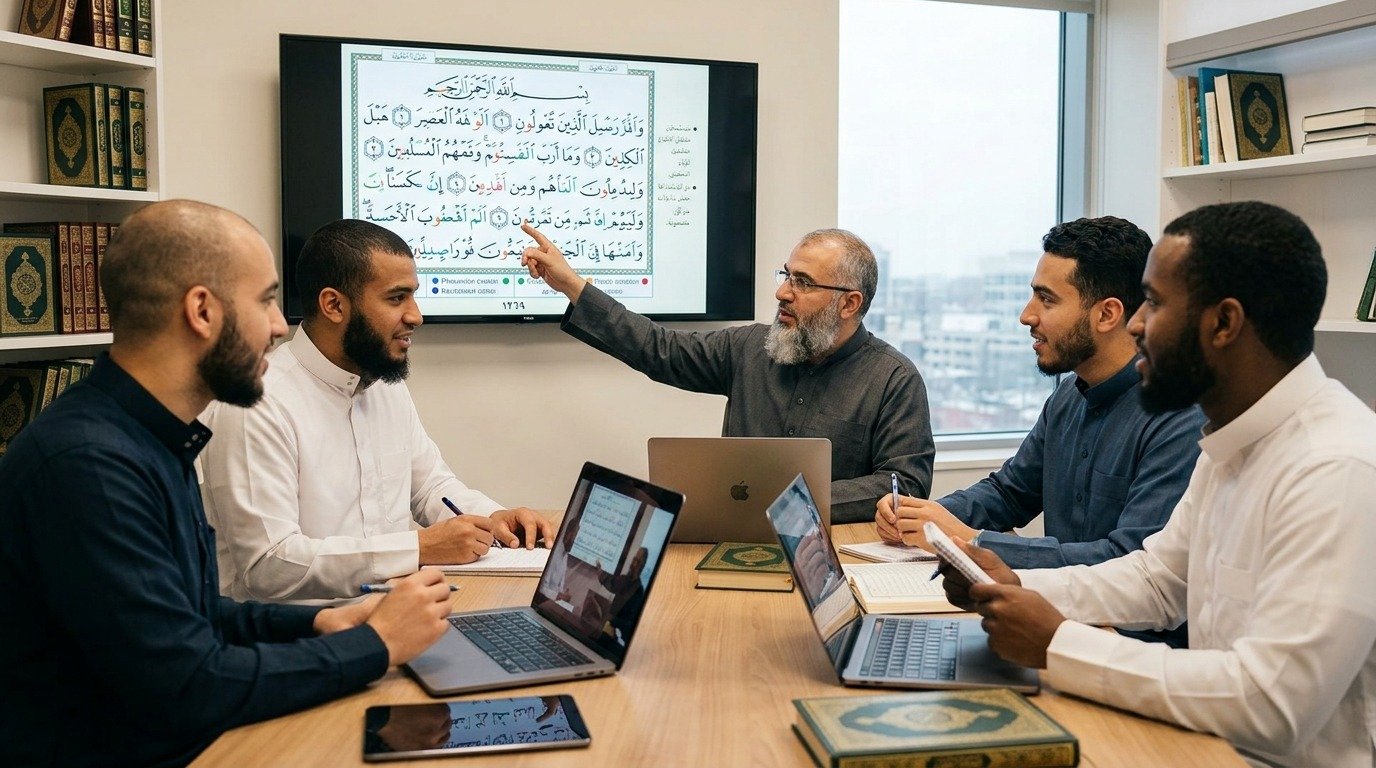
A typical Tajweed focused lesson for a student who already reads reasonably well tends to center on close listening and correction, rather than teaching new letters or basic vocabulary. The teacher listens closely as the student reads a passage, stopping to point out specific rule applications, perhaps a nasalization that was missed, or a letter that needs to be articulated from a slightly different point in the mouth. Over time, lessons also introduce the formal names and categories of these rules, so the student understands not just how to apply a rule correctly, but why it exists and how to recognize when it applies in new, unfamiliar text.
Parent: Are there different levels within Tajweed itself, or is it all one single skill level?
There are definitely levels, even though they are not always formally labeled that way in casual conversation. Basic Tajweed awareness, knowing that certain letters are held longer than others, or that some letters are pronounced from a distinct point in the mouth, gets introduced early in foundational reading instruction. Intermediate Tajweed involves applying a fuller set of named rules consistently, including rules that govern how specific consonant combinations interact. Advanced Tajweed, the level typically associated with ijazah certification, involves extremely precise, consistent application across long stretches of recitation, along with a deeper theoretical understanding of why each rule exists and how it connects to the broader system. Most students progress through these levels gradually over years, not because the material is impossibly difficult, but because true consistency, applying every rule correctly every single time without needing to consciously think about it, simply takes sustained practice to develop.
Parent: My child reads quickly. Does speed matter for Tajweed, or only accuracy?
Speed genuinely matters less than most parents assume, and in fact, reading too quickly is one of the more common obstacles to accurate Tajweed. Many Tajweed rules involve precise timing, holding certain sounds for a specific duration relative to others, and a student who reads quickly often shortens these durations without realizing it, simply because their pace does not allow enough space for the rule to be applied correctly. Teachers frequently ask fast readers to deliberately slow down, sometimes considerably, specifically to give Tajweed rules room to be applied properly. Once accuracy is well established at a slower pace, speed naturally increases again over time without sacrificing correctness, but rushing this process from the start tends to bake in the very inaccuracies that focused Tajweed instruction is meant to correct.
Parent: Is Tajweed harder to learn than general reading?
It depends on how you define hard. The individual rules of Tajweed are not conceptually difficult to understand, most can be explained clearly in a sentence or two. What makes Tajweed genuinely challenging is consistent application, training your mouth and ear to apply dozens of rules automatically, in real time, while reading continuous text, rather than just being able to recite the rule when asked directly. This is why Tajweed mastery tends to take considerable practice and repetition even after a student intellectually understands every individual rule. It is closer to learning a physical skill, like proper form in a sport, than to memorizing a list of facts.
Parent: Does my child need to learn Tajweed before they start memorizing surahs?
This is a common question, and the honest answer is that it works best when Tajweed and memorization develop somewhat together, rather than requiring one to be fully finished before starting the other. A student does not need to have mastered every advanced Tajweed rule before beginning memorization of short surahs, especially ones they may already be familiar with from hearing them recited at home. However, memorizing with incorrect pronunciation habits early on can be harder to unlearn later, so many teachers introduce memorization gradually alongside ongoing Tajweed correction, rather than treating memorization as something that only starts once Tajweed is "complete," since Tajweed refinement genuinely continues for years even among strong readers.
Parent: Is there a way to test whether my child's reading needs more Tajweed focus?
A fairly reliable, informal way to check is to have your child read a short, unfamiliar passage aloud, ideally one they have not memorized or practiced recently, and listen for a few specific things. Are stretched sounds held for a clearly noticeable, consistent length, or do they vary randomly? Are similar sounding letters distinguishable from each other, or do a few of them blend together? Does the pace stay steady, or does the student rush through parts and slow dramatically on others? If you are unsure what you are listening for, this is exactly the kind of thing a teacher can assess quickly and precisely during a trial lesson, since trained ears catch inconsistencies that are genuinely difficult for an untrained parent to identify confidently on their own.
Parent: Can adults benefit from dedicated Tajweed classes even if they learned to read as children?
Very much so, and this is actually one of the more common reasons adults return to structured lessons after years away from formal study. Many adults learned to read the Quran as children through less structured or less rule focused methods, and picked up habits along the way that were never specifically corrected. Revisiting Tajweed as an adult, with a teacher who listens carefully and corrects specific patterns, often produces noticeably more polished, confident recitation, even for someone who has technically been able to read the Quran for decades. It is genuinely never too late to refine this skill, and plenty of online Tajweed classes are specifically designed with adult learners returning to the material in mind.
Parent: How is Tajweed connected to the idea of getting an ijazah?
An ijazah is a formal certification confirming that a student can recite a portion of the Quran, or the entire Quran, with correct Tajweed under the direct guidance and approval of a qualified, certified teacher. Tajweed mastery is essentially the core requirement being tested and certified through this process. A student cannot really pursue an ijazah meaningfully without having already developed strong, consistent Tajweed application, since the certification is specifically verifying pronunciation accuracy according to established rules. Families or individuals interested in eventually pursuing this credential often look into online ijazah classes once their Tajweed and reading fluency are both well established, treating it as a natural next step rather than a starting point.
Parent: Does learning Tajweed help with memorization retention too?
Indirectly, yes, quite a bit actually. When a student applies Tajweed rules consistently, their recitation develops a more natural, rhythmic flow, since many Tajweed rules govern timing and stretching in ways that create a consistent cadence. This rhythmic consistency often makes memorized material easier to retain, since the brain has an easier time holding onto a passage that follows a steady, predictable rhythm compared to one that was memorized with inconsistent timing and pronunciation. Families focused on online Quran memorization classes for kids often find that solid Tajweed instruction alongside memorization actually makes the memorization process itself go more smoothly, rather than being an unrelated, separate skill.
Parent: If we only have time for one type of class right now, which should we prioritize?
For a true beginner, the honest answer is that this is somewhat of a false choice, since foundational reading instruction already includes basic Tajweed concepts from the start, they are not separate tracks at that stage. For a student who already reads fluently but has never had focused correction, dedicated Tajweed lessons are usually the higher priority, since refining existing reading tends to produce noticeable, meaningful improvement relatively quickly, often within a matter of weeks for students who already have a solid reading base to build on.
Parent: Is it normal for a student to plateau in Tajweed progress?
Completely normal, and it happens to nearly every student at some point. Tajweed involves a large number of individual rules, and it is common for a student to master several rules relatively quickly and then spend a longer stretch working on one or two particularly tricky ones, often rules involving letters that are naturally close in articulation point and genuinely difficult to distinguish at first. A patient teacher expects this kind of uneven progress and will often revisit a challenging rule from a few different angles, using different practice words or passages, rather than simply repeating the same explanation until it eventually clicks.
Parent: How long does it typically take to notice real improvement from focused Tajweed lessons?
For a student who already reads with reasonable fluency, many families notice a meaningful, audible improvement within four to eight weeks of consistent, focused Tajweed correction, particularly around the specific rules the teacher chooses to emphasize early on. Full mastery across the complete set of rules, applied consistently and automatically across any passage, generally takes considerably longer, often many months to a couple of years depending on lesson frequency, but the early, noticeable improvement tends to be genuinely motivating for both students and parents, since it confirms fairly quickly that the focused approach is working.
Parent: One last question. Is it worth explaining this distinction to my child directly, or should I just enroll them and not worry about the terminology?
It is genuinely worth a brief, simple explanation, even for a young child. Something as short as "reading means knowing the words, Tajweed means saying them exactly right" gives a child a helpful mental framework for understanding what their teacher is correcting them on, rather than experiencing corrections as vague or confusing. Older children in particular tend to engage more thoughtfully with lessons once they understand the purpose behind specific corrections, rather than just being told to repeat a sound again without context for why it matters.
Parent: Do different teachers sometimes teach Tajweed slightly differently, and does that matter?
There can be minor differences in emphasis or teaching style between teachers, largely because different scholarly traditions and regional teaching styles have developed slightly different approaches to explaining and sequencing the same underlying rules. These differences are generally minor and do not represent conflicting or contradictory information, more like different paths to the same destination. What matters far more than which specific teaching tradition a teacher follows is whether that teacher is genuinely qualified, listens carefully, and corrects consistently. A family switching teachers partway through a child's Tajweed journey should not expect to start over from scratch, though there may be a short adjustment period as the student gets used to a slightly different explanatory style or terminology for familiar concepts.
Parent: Can group classes teach Tajweed effectively, or does this really require one on one attention?
Both formats can work, though they serve slightly different purposes well. Group classes can effectively introduce and reinforce general Tajweed concepts, especially for students at a similar level who benefit from hearing each other read and receive shared correction. However, because Tajweed accuracy often comes down to very specific, individual pronunciation habits, many families find that at least some one on one attention, even if only periodically alongside group lessons, helps catch and correct the particular small errors that are unique to their child and might otherwise go unnoticed in a larger group setting. Some families structure this as regular group lessons supplemented by occasional individual sessions focused specifically on Tajweed refinement, which tends to combine the social engagement of group learning with the precision of individual correction.
Parent: Is there a risk of a student becoming overly perfectionistic about Tajweed and losing enjoyment of reading altogether?
This is a genuinely thoughtful concern, and it does happen occasionally, particularly with older children or teenagers who are naturally inclined toward perfectionism in other areas of their life as well. A good teacher watches for this and deliberately balances correction with encouragement, celebrating overall progress and fluency rather than treating every single lesson as a search for errors to fix. If you notice your child becoming anxious or discouraged rather than motivated by Tajweed correction, it is worth mentioning this directly to the teacher, since pacing and tone can usually be adjusted without abandoning focused instruction altogether. The goal of Tajweed is ultimately to deepen a positive, confident relationship with reading, not to create anxiety around getting every detail perfect on the first try.
The short version, if you only remember one thing
Quran reading is the broad skill of voicing the words correctly. Tajweed is the detailed rulebook that makes that voicing precise and accurate. They are not separate, competing tracks, they are deeply connected, with Tajweed woven into reading instruction from the very beginning and deepening progressively as a student advances. Whether your family is just starting out or looking to refine reading that is already fairly strong, understanding this relationship helps set clearer, more realistic expectations for what a lesson plan should actually focus on at each stage.
If you are trying to figure out where your own child or you currently stand between these two connected skills, families near online Quran classes in Chicago and across the country have found that a short trial lesson is usually the fastest, clearest way to get a specific, personalized answer, rather than trying to guess from a general guide like this one.
Parent: One more thing, does this distinction even matter for very young children just starting out?
It matters less as a topic of conversation with a four or five year old, and more as a framework for you as the parent to understand what is actually happening during those early lessons. A young child does not need to know the word Tajweed at all in their first year of lessons. What matters is that you understand their teacher is not just teaching them to recognize letters, they are simultaneously building correct pronunciation habits from day one, which is exactly why foundational instruction moves a little more slowly and carefully than some parents initially expect. Knowing that this groundwork is happening, even without formal Tajweed terminology being used yet, can help you appreciate why patience during those early months genuinely pays off later, when your child transitions into more advanced material with far fewer habits that need correcting along the way.
In the end, whether you call it reading, Tajweed, or simply "learning to say it right," the goal your family is working toward is the same one that generations of learners before you have pursued: clear, accurate, confident recitation that a student can carry with them for the rest of their life, refined a little more with every lesson along the way.
Add New Comment